
Double Dragon: from arcade cabinets to a shared legend
Billy and Jimmy Lee, the two brothers at the heart of Double Dragon, first took to the streets in 1987. Explore the series’ arcade beginnings, distinct home versions, screen-inspired spin-offs and modern sequels.


Billy and Jimmy Lee are two brothers, martial artists and the main heroes of the Double Dragon series. In the original 1987 game, they set out to rescue the kidnapped Marian. Players guide them through streets and other locations, defeating groups of enemies with punches, kicks and weapons picked up along the way. This type of game is called a beat ’em up. The arcade version allowed two people to play at once: each controlled one brother, working together against the odds.
Playing together, including the occasional accidental hit on your friend’s character, made Double Dragon memorable. The series’ history, however, is no simple sequence from one to five. The same title can hide different games on different machines, and a higher number does not necessarily mean a direct sequel.
In this article, we follow the series’ entire journey, from Japanese arcade machines through home computers and consoles to its modern returns. Alongside familiar releases for the Nintendo Entertainment System, or NES, and the handheld Game Boy, there is room for the Master System, Amiga, PC Engine, Neo Geo and the unusual Zeebo. Years below refer to a game’s first release; regional launches may differ.
1986: before the dragons came Kunio
Double Dragon was created by the Japanese game development studio Technōs Japan. One of its principal creators was game designer Yoshihisa Kishimoto, who helped shape its rules and combat. To understand where the idea came from, we need to go back one year. In 1986, Kishimoto had worked on the arcade game Nekketsu Kōha Kunio-kun. Its hero was Kunio, a schoolboy fighting street thugs; the game was reworked for Western markets and renamed Renegade. Players could move not only left and right but also up and down across the street. Double Dragon built on that approach to fighting and added a major attraction: two players battling together.In an interview with gaming website Polygon, Kishimoto explained that two-player cooperation also had a commercial purpose. A cabinet that accommodated two people at once could bring in more money. The Lee brothers’ shared adventure therefore reflected the practical economics of arcades too. Actor and martial artist Bruce Lee was among the creative inspirations.

Renegade in a museum display: the NES cartridge and box. This photograph shows the later home release, not the 1986 arcade machine. Digital Game Museum · CC BY 2.0.
1987: the real beginning was an arcade cabinet
The first Double Dragon launched in 1987 for arcade machines: standalone cabinets with a screen, joysticks, buttons and a coin slot, of the kind found in amusement arcades. Technōs Japan developed the game, while Taito distributed it in North America. It did not begin as a Nintendo game. Billy and Jimmy travel through four missions to rescue Marian. Punches and kicks are joined by throws, elbow strikes and weapons taken from enemies.Its fundamental appeal lies in space. Being close is not enough: you need to line up correctly, watch your back and decide who handles the second opponent. A crate or bat on the ground is an opportunity to change a fight, not merely scenery.
Even cooperation has a catch. If both players survive past the final enemy, they must fight each other for Marian. To modern eyes, it is an odd ending to a rescue mission, but for an arcade it was a fine way to turn the final screen into a shared memory.

The illuminated Double Dragon marquee at Yestercades in Red Bank, photographed in April 2015. Rob DiCaterino · CC BY 2.0.
Home versions: one name, many different games
The NES and its Japanese counterpart, the Famicom, received a substantially altered version in 1988. New techniques unlock through experience, stages and story change, and two players take turns in the main game. A separate versus mode does not provide a cooperative campaign. The Master System, by contrast, retained co-op. Already, “Double Dragon” no longer meant the same experience on every machine.The original also spread to the ZX Spectrum, Commodore 64, Amstrad CPC, MSX, Amiga, Atari ST and DOS. Other destinations included the Atari 2600 and 7800, Game Boy, Mega Drive/Genesis and Atari Lynx. Differences in memory, graphics and controls affected the rhythm of combat itself, not just the number of colors.
The Atari 2600 is a particularly interesting example: the 1989 release squeezed the arcade brawler’s premise into a console introduced in 1977. The Spectrum shows how differently the more colorful first game and its largely monochrome sequels could feel. And beware of the Game Gear title: its 1993 Double Dragon is a separately designed adventure, not a simple reduction of the Master System game.

The Revenge: an arcade sequel and a home favorite
Double Dragon II: The Revenge emerged around the turn of 1988 and 1989; catalogs commonly give 1988, while some regional releases fall in 1989. The arcade game turned Marian’s rescue into revenge and assigned attacks to directions. Speaking to PlayStation Blog, Kishimoto recalled roughly three developers working for three months. That is his retrospective estimate, not a figure applying to every conversion.The Famicom in 1989 and Western NES in 1990 received a heavily reworked game with nine missions and genuine cooperative play. Precisely timed powerful techniques share the stage with hazardous jumps and moving obstacles. For many players, this sequel became their defining memory of the series.
Computer conversions and the Mega Drive followed the arcade branch. The 1993 PC Engine Super CD-ROM² version instead drew on the home interpretation, adding CD presentation. Matching Roman numerals on the box are therefore not enough for a meaningful comparison.
Two different third games, linked by mysterious stones
East Technology developed the 1990 arcade Double Dragon 3: The Rosetta Stone for Technōs. The adventure expanded across several countries and introduced shops. In some arcade versions, upgrades required additional real credits. Calling this the first microtransaction system in history without qualification would nevertheless be too categorical.The 1991 NES Double Dragon III: The Sacred Stones is a different Technōs game. Chin Seimei and Ranzou join the brothers, with each fighter having an individual health supply. The famous “Bimmy” typo appears in the two-player opening text; it is not a newly assigned name for the hero.
Computer versions of Rosetta Stone and the Game Boy’s The Arcade Game belong to the arcade branch. The Sales Curve’s Spectrum III requires 128K, and purchases compete with the limited credits needed to continue. A similar story premise thus leads to two different ways of playing.

Double Dragon 3 running on an Amiga 1200 at RetroGaming Days IV in Évreux in March 2015. Frédéric BISSON · CC BY 2.0.
Game Boy: the biggest mix-up is Double Dragon II
The first handheld Double Dragon, released in 1990, has its own stage layouts. The Game Link cable, which connects two Game Boys, supports player-versus-player fighting; the main adventure is single-player.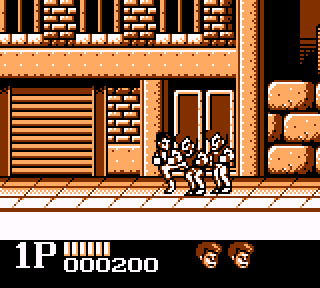
The 1992 third entry then brought a handheld adaptation of the arcade Rosetta Stone. Collecting all three cartridges also gives you a small survey of the very different ways the license was handled.
1992: Super Double Dragon and the art of defense
Super Double Dragon for SNES, known in Japan as Return of Double Dragon for Super Famicom, is an original console sequel. Blocking, catching a punch and counterattacking give combat a different flavor from simply repeating an attack button. The Japanese and Western releases also differ in their details.Designer Muneki Ebinuma later described omitted story scenes and obstacles that never reached the finished game. A simple final narrative does not necessarily mean a simple original plan. Those proposals should not, however, be mistaken for hidden content that players can normally unlock.
1993: enter the Battletoads
Battletoads & Double Dragon teamed the brothers with Rash, Zitz and Pimple, the three fighting mutant toads from the Battletoads series. Rare created an adventure in which brawling alternates with vehicles, ropes and other tests of reflexes. It appeared on NES, Game Boy, SNES and Mega Drive/Genesis.Programmer Paul Machacek recalled considerable creative freedom for Rare when discussing the license with Retro Video Gamer. The result is a crossover with a strong Battletoads identity, rather than another numbered Double Dragon.
Platform matters again: NES offers cooperative play, whereas Game Boy is single-player only. Even five selectable heroes tell you nothing by themselves about the number of simultaneous players.
Television, cinema and two fighting-game detours
The animated series began in 1993, followed by the live-action film in 1994. They gave the brand a life beyond arcades, although its various incarnations told very different stories.The 1994 Double Dragon V: The Shadow Falls for SNES and Mega Drive/Genesis draws on the animated series. It reached the Jaguar in 1995. Instead of progressing through streets, players fight one-on-one, so the Roman numeral V can mislead anyone expecting another traditional brawler.
A separate title is the 1995 Double Dragon for Neo Geo, inspired by the live-action film. Neo Geo CD followed, then PlayStation in 1996. These two fighters must be distinguished: they are not different names for the same game. Similarly, 2002’s Rage of the Dragons is a separate property, not an official numbered Double Dragon installment.
After Technōs: Advance and smaller screens
The demise of the original Technōs in the mid-1990s did not end the series. The rights later belonged to Million, the company behind 2003’s Double Dragon Advance for Game Boy Advance, published by Atlus. It returns to the arcade foundations while adding stages and expanding combat. This is a considered reworking, not merely the original cabinet running in emulation.Phones before today’s app era deserve a mention too: Bandai’s mobile Double Dragon arrived in 2004, followed by Double Dragon EX. In 2007, an updated version of the classic reached Xbox Live Arcade on Xbox 360.
Another remarkable stop is Zeebo, a console associated particularly with Brazil. Brizo’s 2009 Double Dragon offers its own reworking, and Brizo also developed the 2011 iPhone version. The brand’s history includes platforms many European players have never held.
Neon, Wander and a return to eight bits
WayForward’s Double Dragon Neon arrived in 2012 on PlayStation 3 and Xbox 360, later reaching PC and Switch. Cassettes, vivid colors and playful exaggeration make it a deliberate celebration of the 1980s. Returning to a classic can also mean finding a new interpretation of its mood.The 2013 Xbox 360 release Double Dragon II: Wander of the Dragons represents a different attempt to bring the brand into 3D. That same year, Dotemu released Double Dragon Trilogy for mobile devices, followed by PC in 2015. It collects the three arcade games, not the NES trilogy.
The rights passed from Million to Arc System Works in June 2015. Double Dragon IV in 2017 deliberately chose the look of the home eight-bit sequel. Kishimoto and other veterans returned to contribute. The initial PC and PS4 releases were followed by Switch. A fourth game appearing after a fifth is no calendar error: it reflects the series’ separate branches.
Gaiden and Revive: two modern approaches
Secret Base’s Double Dragon Gaiden: Rise of the Dragons launched on July 27, 2023 for PC, Switch, PS4, PS5, Xbox One and Xbox Series X|S. Switching between a pair of heroes and roguelite elements encourage repeated runs. Here, roguelite means trying different teams and upgrades on later attempts while gradually unlocking more options. Playable Marian also changes the old premise: the person once being rescued now joins the fight.Double Dragon Revive launched on October 23, 2025. YUKE’S participated in development, with Arc System Works publishing. It reached PC, Switch, PS4, PS5, Xbox One and Xbox Series X|S, presenting the cast in modern 3D graphics. It is a new title, not a repackaging of the 1987 arcade game.
This era also includes the bonus game Double Dragon Dodgeball and Billy and Jimmy’s appearance in the 2024 River City Girls 2 expansion. The dragons thus meet the Kunio-kun family again, bringing the story back toward its roots.
Reissues and a legacy that still has a partner
New releases of old games should be distinguished from new sequels. Arcade Archives makes the arcade titles available; Double Dragon Collection, first released in Asia for Switch in 2023, brings together six games including Super Double Dragon and Advance. Virtual Console brought selected older versions to systems including Wii, Wii U and Nintendo 3DS. A reissue’s platform alone does not tell you which original it contains.Yoshihisa Kishimoto died on April 2, 2026, aged 64. His work lives on in a simple situation every series fan recognizes: another group enters the screen, and someone beside you says they will handle the right side.

Double Dragon at the far right among other cabinets at Yestercades in Somerville, May 2015. The classic lives on in retro arcades. Rob DiCaterino · CC BY 2.0.
That immediate clarity is what we value about Double Dragon. Rules, graphics and tone change between versions, but helping another player at the right moment can be a greater reward than any score. Comparing the actual games is therefore more interesting than comparing their boxes.
Double Dragon in our catalog
These links lead to articles about specific versions, including controls, tips and further sources. Each article concerns the platform named.ZX Spectrum


Nintendo Entertainment System


Game Boy


Atari 2600
Sources and further reading
We compared original manuals, period material, developer interviews and publisher information. Detailed sources for the home versions appear in the linked game articles.- Polygon — Yoshihisa Kishimoto (2012)
- PlayStation Blog — Yoshihisa Kishimoto (2016)
- Game Developer — Double Dragon IV (2017)
- Museum of the Game — Double Dragon II
- MobyGames — Double Dragon 3: The Rosetta Stone
- Game Kommander / Double Dragon Dojo — Muneki Ebinuma
- Retro Video Gamer — Paul Machacek
- Arcade History — Double Dragon (Neo Geo)
- MobyGames — Double Dragon (Game Gear)
- Arc System Works — 2015
- Xbox Wire — Double Dragon (2007)
- MobyGames — Double Dragon (Zeebo)
- GameSpot — Double Dragon (2004)
- MobyGames — Double Dragon EX
- WayForward — Double Dragon Neon
- Dotemu / Steam — Double Dragon Trilogy
- GameFAQs — Double Dragon II: Wander of the Dragons
- Secret Base / Steam — Double Dragon Gaiden
- Arc System Works — Double Dragon Collection
- WayForward — River City Girls 2: Double Dragon DLC
- YUKE’S — Double Dragon Revive (2025)
- Arc System Works — Double Dragon Revive
- Gematsu — Yoshihisa Kishimoto (2026)
Sir Gamer
ZX Spectrum maniac